Showing posts with label tera hunter. Show all posts

Wednesday, March 12, 2014

dancing in funky streets...can you dig it

 
Today three more students did their spoken word presentations. Ann Marie recasted Martha and the Vandella's "Dancing in the Street" (She did as much with inspiration from Marvin Gaye's 1971 hit "What's Going On" because Gaye helped pen the Vandella's hit. I didn't know this. I am big fan of the album on which this song appears. As I told the students, it was the first album I listened to from beginning to end with tears in my eyes). Katarina Thompson recasted Wilson Pickett's 1967 hit "Funky Broadway" and  Trakayla recasted Parliament's 1975 hit "Chocolate City" (which is an alternately revolutionary and humorous nod to Washington D.C.) All this as we moved beyond discussing themes often associated with black urban life in America, among them resistance, identity, labor and housing.

We will now turn to how how scholars have historically written about African American life in the urban space. While W.E.B. Dubois certainly christened this subfield of African American history with his late nineteenth century study on the Philadelphia Negro, the students learned that in the opening decades of the twentieth century Chicago was the site to which many scholars often turned  to better understand black life in urban spaces. Stay tuned for excerpts from the students' reflections on what we discussed in class today.  Chicago figured greatly into our conversation.

Meanwhile, I look forward to next week's class and hearing their thoughts on two writings that have helped shaped black urban literature: St. Clair Drake and Horace Clayton's 1945 study Black Metropolis, which is indeed centered on Chicago, and Gilbert Osofsky's 1968 study which presents Harlem as an "enduring ghetto." The class will  do well to prepare by first starting with the introductory pages to a recently published edited collection of essays on black urban life by Joe W. Trotter with Earl Lewis and Tera Hunter.


Wednesday, March 5, 2014

an empire state....that thing


Cooper's novel unveils complexities of urban space

Kerry Washington stars as Olivia Pope
Today Callie and Dushane presented their spoken word presentations. Dushane recast "Empire State of Mind" by Jay-Z featuring Alicia Keys and Callie recast Lauryn Hill's "Doo Wop (That Thing)." Again, another set of impressive performances. The students are truly understanding the complexities of urban life when race is part of the equation. 

In today's discussion, we also took up the issue of class and gender by looking at black female laundry workers in postbellum Atlanta as presented in a monograph by historian Tera Hunter. We juxtaposed those women's experiences against the migrating working class women of color under surveillance in northern cities during the interwar period as presented by historian Hazel Carby. 

In an effort to help the students see the degree  to which African American women in both narratives had "self-determined" spirits no matter the level of their oppression, I encouraged them to turn to Olivia Pope, a character in a modern day television drama's "Scandal" (I did as much because I earlier saw some of them enthusiastic about this show). A lively conversation ensued, so much so Callie set up a Group Me app and we will all watch tomorrow's episode separately and continue talking about the specific experiences of African American women who, as Carby explains, created a "moral panic" for both whites and the black elite after migrating north. Jake noted how the iconic "Miss Anne," or white women who spent time in Harlem among African American artists and musicians, created panic, too. It will be interesting to see what new things we will learn about such panic and about the urban space via Pope. 

We will  continue discussing such issues next week while turning to an excerpt from J. California Cooper's Some People, Some Other Place, an imagined work unveiling a woman who could easily be one of the women Carby is describing. Eula Too has recently arrived in a Chicago suburban home as a new migrant from the South. She finds an unlikely friend and employer. We will also turn to Reynolds Farley's essay on the urbanization of "the Negro" in the United States as another avenue to continue thinking about how urban life was increasingly defined by the black body. We will also read Allan Spear's essay on how white racism affected residential patterns in 20th century Chicago. Farley and Spear's writings will set the stage for how we, among other things, consider the "tone" of historical scholarship on black urban life and how it came to be that Chicago is often front and center when we look at academic work on African American "urban" experiences.

Friday, February 28, 2014

on taking long walks on the "A" train

Here are excerpts from two students reading from their spoken word presentations after class this week. Elizabeth recast Duke Ellington's "Take the A Train" and Apryl recast Jill Scott's "A Long Walk." The ways in which both students  made their presentations personal and historical was quite impressive. 

Notably, Apryl used the University of Alabama as a political landscape to take a long walk. Among places she rhetorically visited was the "schoolhouse" door on Foster auditorium where Governor George Wallace stood in 1963 in an attempt to delay the segregation of the university.

Elizabeth was more drawn  to the difficulties of urban living as seen in the  dilapidated buildings often inhabited by African Americans in cities, and to the specific challenges that black girls and women face in a modern world anywhere. She used the "A" train -  which, as the song tells us,  goes to Harlem - as a metaphor for a new kind of journey that African American women and girls could take that would allow them to harness their stronger selves anywhere. As an aside, I was very proud to sit this week beside Elizabeth on a Black Feminism panel, which was sponsored by the Women's Resources Center here at the university. 

Jake and Shayla, two more students, also presented. Jake did a wonderful job recasting the 1950s rhythm and blues song "Kansas City" and Shayla recast Janelle Monae's recent hit "Q.U.E.E.N."

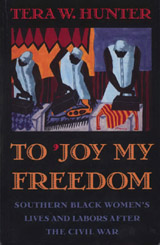
Tera Hunter's book on black female labor.
On another note, the class took up the issue of mobility again as it relates to life in and outside the urban space by discussing the upheaval that white and black Americans experienced during the Civil War as relayed in Yael Sternhell's Routes of War: The World of Movement in the Confederate South. We juxtaposed that book against an excerpt from Dolen Perkins-Valdez' Wench  that unveils the first time a group of four enslaved women enter the city of Dayton without the oversight of their white masters. Both readings put the idea of "transitions" squarely before us, something we will want to continue thinking about when we turn to an excerpt from Tera Hunter's To 'Joy My Freedom: Southern Black Women's Lives and Labors after the Civil War and Hazel Carby's look at how black women's bodies were under surveillance in urban spaces at the turn of the century. As we read, we will want to keep in mind how time figures into black mobility. We will want to wonder about the things that black bodies could and could not do before and after the Civil War. We should also wonder how gender pushes our thinking on this matter. With Carby in mind, we should also be very attentive to whether or not there is a monolithic black female experience, or whether there are differences, as Wench seems to suggest, in how some black women experience oppression. Finally, we should also be thinking about how geography figures into everything before us. For example, what makes the efforts of black laundry workers in Atlanta extremely significant for the "South"? I look forward to a hearty discussion on these and other issues
next week.

Monday, March 11, 2013

"from lynchings in Texas to room service in Massachusetts"


Jurnee Smollett-Bell, Nate Parker, and Denzel Whitaker star in The Great Debaters.
The students learned this week about the experiences of African Americans during the postbellum period. They did so partly by juxtaposing an excerpt from Tera Hunter's study of African American female laborers in Atlanta and an excerpt from Martha Sandweiss' study on the experiences of Georgia-born Ada Copeland  faced as a  domestic worker in New York (and as the "black" wife of the white geologist Clarence King who passes as an African American) against the 2007 motion picture The Great Debaters. Like the readings, the film uncovers the ongoing oppressed conditions for African Americans amid racial progress. Set in the 1930s, the film depicts the trials and triumphs experienced by four members of an award-winning debate team from a Texas-based African American college  who eventually travel by train to debate their white Harvard opponents. Tiffany observed how the movie "perfectly illustrated the 'heightened...awareness of race" in Jim Crow America, which Sandweiss addresses in her examination of the different worlds Copeland and her white husband inhabited in New York. As Tiffany wrote, while maneuvering between "lynchings in Texas to room service in Massachusetts, the 'Great Debaters'  felt a "sense of wonder and astonishment...at being far from the crushing racial order of the South" (the latter part of her sentence uncovers her use of a quote from African American novelist Paul Laurence Dunbar). Aaron focused more on the changes in black-white relations - as made evident in the white Harvard student who offered to carry their luggage - the debaters saw while visiting Massachusetts. Lauria noted how blacks were "still see as inferiors" though "Harvard gave [the debaters] a chance to be ...seen as students with great minds." Alexis noted how the Great Debaters did not let "fear...stand" in their way. They forced their opponents to see how ideas concerning "morality and justice" were no longer suitable only for others in distant places, but for them, too. In this way, they were not unlike the  African American domestic workers who formed kinship networks in their community and churches after migrating South for the North to improve their lives.  Kalynn honed in on the debaters' grappling over the "basic rights of human[s]," something she also observed in the Atlanta female washerwomen. But not all was not well in Jim Crow America as made evident in obviously educated Wilson, the African American man who worked as a butler at Harvard even though he could translate Latin. Speaking to this, Roosevelt wrote, in the North, "poor conditions" remained. Roosevelt also detected, too, the ways in which women working as domestic workers faced special challenges, among them, sexual oppression while working in the homes of white Americans. Christin saw how the debaters "faced...[the] stubborn mindsets of people not willing...to change" including a police officer who asked them if they were "supposed to be" in the Harvard hall where their debate would take place. Raven maintained, in the end, there has not been as much racial progress as people believe because "blacks were...and still are underestimated" not unlike the African American washerwomen in postbellum Atlanta.

Sunday, March 10, 2013

the city as a gendered personal and a work space


This week, we will finally discuss African American city life in the years following the Civil War. The two texts before us are Tera Hunter's study on African American women's personal and work lives in postbellum Atlanta and Martha Sandweiss' investigation of a hidden interracial romance in New York during the same period. In both books, the students will  pay close attention to gender. They will be asked to look for how the labor experiences of African American women workers differ from others. They will also think deeply about the ways in which the city became the pulse of American life as the century closed and the challenges/triumphs such a dynamic posed for people of African descent, women in particular. Among other things, they will ponder how and why residential patterns changed after the war.