 |
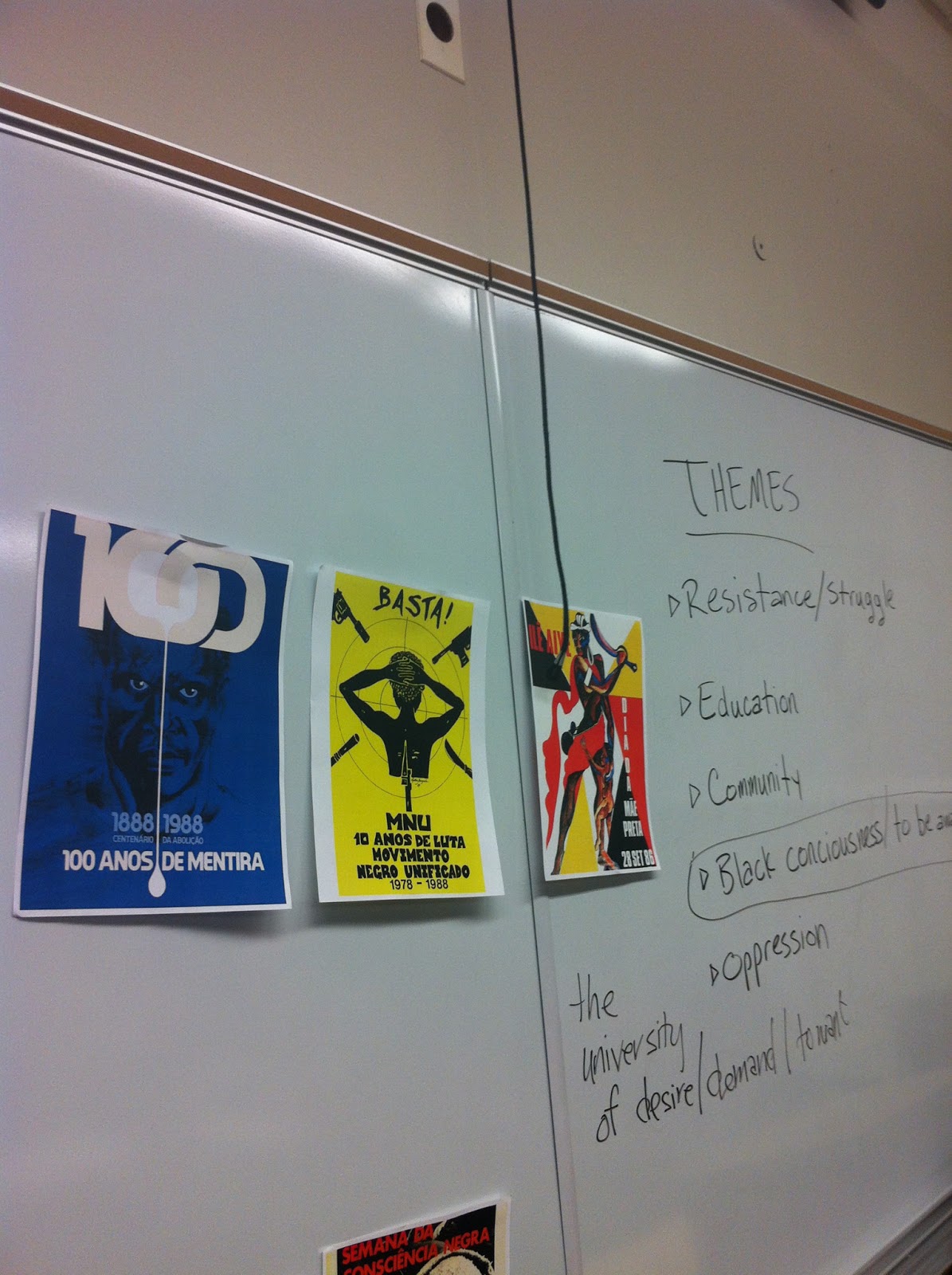
| Copies of the posters to be used in an upcoming art exhibition. |
Showing posts with label jamaica. Show all posts
Showing posts with label jamaica. Show all posts
Thursday, February 21, 2013
different meanings of "blackness"


Sunday, December 9, 2012
Afro Brazilian and African American struggle poster exhibition

This blog ends the year 2012 with an announcement and an
opportunity. Students taking “African Americans in the City” next spring at the
University of Alabama will have a chance to work on a project centered around a group of posters found in Charles Town, West Virginia, which unveil the shared
struggles of African Americans during the era generally known as the Civil Rights movement. Brazilian researcher Amilcar Pereira and UA's History professor Teresa Cribelli will coordinate. Using information learned in the course, the class will collectively write a curatorial statement. The project will culminate in an exhibition to be held April 28 at the University. Among the tasks will be exploring how
“black” means one thing in the United States, but often something entirely else in the Caribbean
and Latin America. For example, C.L.R. James' study of the Haitian revolution uncovers how elite people of mixed race were pitted against African slaves during the late eighteenth century in that country. Ula Taylor's exploration of the life of Amy Jacques Garvey, wife of the famous political leader, Marcus Garvey, learned upon her entry into Harlem in 1917 that meanings about "black" differed from those in her native Jamaica where people were generally known as "black," "brown" and "white." In her investigation of how “blacks”became invisible in Colombia, Aline Helg reveals how
the costenos, or people of color on la Costa or the Atlantic coast of Colombia, shied
away from racially distinguishing themselves even though anthropologists have
noted racial stereotyping of this group by others. Interestingly, Helg discovered that the lack of transportation
and communication between the frontier, cities and towns compelled people, including the costenos, to
focus more on their immediate environment, and not the “country” as a whole for identity purposes. Her findings are striking given that Colombia at the time of her 2004 study had the
largest population of people of African descent in the “Western” world outside
of the United States and Brazil. What allows some
countries to create racial ideologies and prohibits others from fully doing the
same? How do people of color in different countries still manage to come together to address their shared oppression? These are among the questions this course will try to answer. From time to time, students will write future blog entries here. Again, happy
holidays and all best in the new year!