Sunday, March 17, 2013

race, ghetto and underclass talk


Gordon Parks' photography has often captured African American life in cites

The transformation of rural African Americans into urban people is a twentieth century event. By World War II, more blacks lived in cities than in the countryside.  As they settled in, African Americans were affected by many things including deindustrialization, high unemployment and residential segregation.  Scholars, among them, W.E.B. Du Bois, Charles S. Johnson, E. Franklin Frazier, St. Clair Drake,  Horace R. Cayton. Gilbert Osofsky and Williams Julius Wilson, have contributed to the growth of black urban studies as a scholarly field. After initially focusing on northern cities like Chicago, New York and Philadelphia, researchers have in recent decades concentrated on urban communities across the nation. This week, the students taking this class will think about how African American life in cities has been shaped by critical attention to race, ghettoes and what has been called the “underclass.”

Monday, March 11, 2013

"from lynchings in Texas to room service in Massachusetts"


Jurnee Smollett-Bell, Nate Parker, and Denzel Whitaker star in The Great Debaters.
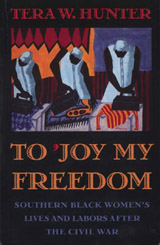
The students learned this week about the experiences of African Americans during the postbellum period. They did so partly by juxtaposing an excerpt from Tera Hunter's study of African American female laborers in Atlanta and an excerpt from Martha Sandweiss' study on the experiences of Georgia-born Ada Copeland  faced as a  domestic worker in New York (and as the "black" wife of the white geologist Clarence King who passes as an African American) against the 2007 motion picture The Great Debaters. Like the readings, the film uncovers the ongoing oppressed conditions for African Americans amid racial progress. Set in the 1930s, the film depicts the trials and triumphs experienced by four members of an award-winning debate team from a Texas-based African American college  who eventually travel by train to debate their white Harvard opponents. Tiffany observed how the movie "perfectly illustrated the 'heightened...awareness of race" in Jim Crow America, which Sandweiss addresses in her examination of the different worlds Copeland and her white husband inhabited in New York. As Tiffany wrote, while maneuvering between "lynchings in Texas to room service in Massachusetts, the 'Great Debaters'  felt a "sense of wonder and astonishment...at being far from the crushing racial order of the South" (the latter part of her sentence uncovers her use of a quote from African American novelist Paul Laurence Dunbar). Aaron focused more on the changes in black-white relations - as made evident in the white Harvard student who offered to carry their luggage - the debaters saw while visiting Massachusetts. Lauria noted how blacks were "still see as inferiors" though "Harvard gave [the debaters] a chance to be ...seen as students with great minds." Alexis noted how the Great Debaters did not let "fear...stand" in their way. They forced their opponents to see how ideas concerning "morality and justice" were no longer suitable only for others in distant places, but for them, too. In this way, they were not unlike the  African American domestic workers who formed kinship networks in their community and churches after migrating South for the North to improve their lives.  Kalynn honed in on the debaters' grappling over the "basic rights of human[s]," something she also observed in the Atlanta female washerwomen. But not all was not well in Jim Crow America as made evident in obviously educated Wilson, the African American man who worked as a butler at Harvard even though he could translate Latin. Speaking to this, Roosevelt wrote, in the North, "poor conditions" remained. Roosevelt also detected, too, the ways in which women working as domestic workers faced special challenges, among them, sexual oppression while working in the homes of white Americans. Christin saw how the debaters "faced...[the] stubborn mindsets of people not willing...to change" including a police officer who asked them if they were "supposed to be" in the Harvard hall where their debate would take place. Raven maintained, in the end, there has not been as much racial progress as people believe because "blacks were...and still are underestimated" not unlike the African American washerwomen in postbellum Atlanta.

Sunday, March 10, 2013

the city as a gendered personal and a work space


This week, we will finally discuss African American city life in the years following the Civil War. The two texts before us are Tera Hunter's study on African American women's personal and work lives in postbellum Atlanta and Martha Sandweiss' investigation of a hidden interracial romance in New York during the same period. In both books, the students will  pay close attention to gender. They will be asked to look for how the labor experiences of African American women workers differ from others. They will also think deeply about the ways in which the city became the pulse of American life as the century closed and the challenges/triumphs such a dynamic posed for people of African descent, women in particular. Among other things, they will ponder how and why residential patterns changed after the war.

Monday, March 4, 2013

on race and place


 Marpessa Dawn played Eurydice in "Black Orpheus."
Aline Helg's study on race in Colombia

In last week’s readings, we explored how the “meanings of blackness” for people of African descent can change depending on several factors including class and geography. As Aline Helg demonstrates in her study of the Caribbean rim of Colombia, many people of color identified themselves based on region rather than skin color even though they encountered some of the same stereotypes and oppression that people of African descent have generally experienced across time. The students saw how the latter idea played out in Colombia and Jamaica, but also Brazil. They watched the 1959 film “Black Orpheus,” a French re-telling of the Greek myth, which is set in Rio de Janeiro.  Lauria, one student, observed how dark skinned Brazilians featured in this imagined work seemed to have “worse off living conditions.” Roosevelt, yet another student, took the idea of complexion further by drawing our attention to the experiences of lead character Eurydice, a fair-skinned women of color (His observation struck me as I would like to see this class better tackle the issue of women and gender. I feel even more strongly about this as I just attended a women’s and gender conference at my home university in Illinois). The departure point for Roosevelt’s observation was his witnessing the horrific ending to Eurydice's life. Noting that Eurydice's experiences fit the "tragic mulatto" trope, which, among other things, incorrectly blames race-mixing - rather than racism - for the troubles endured by biracial people, he said some of the challenges she faced stemmed from her not being “fully black" (i.e. her seemingly beautiful fair skin, an outcome of her being of mixed race, contributed to her fate). Tiffany, another student, brought the idea of skin complexion together with geography and racial politics. Returning to the Helg reading, she thought about the ways in which people of African descent often lacked unity in Colombia because of the "territorial fragmentation" in their country. But Tiffany was still attentive to how people of African descent also separated themselves based on race. She wrote, “People often assume that people of color are automatically unified based on the fact that we have often been identified as [the] ‘other.’ …This idea is both true and false…Whenever something ‘bad’ happens involving a ‘black person,’ some [black] people rush to lament [those] who  make… us look bad. But, …black people [still see difference even amongst themselves when they separate] themselves into categories [like] light-skin, dark skin [and] brown skin.” As we go forward, we will hopefully keep thinking about how race, place and gender intersect in discussions involving cities. We will also think about how certain bodies' association with urban spaces in this course thus far are most often related to labor needs or desires (certainly Eurydice's streetcar driving Orpheus, and the working women in urban Jamaica and Colombia, demonstrate as much). As we continue, we will also see how that narrative changes. Next week's readings take us to the experiences of postbellum washerwomen of color in Atlanta and an interracial couple residing in Gilded Age New York.


Saturday, February 23, 2013

"he made the sun rise"

The 1959 motion picture, Black Orpheus, will offer an opportunity for students taking this course to explore the political and social meanings of "blackness" in and outside the United States. Here is a clip featuring the final scene from the movie, which is set in the city of Rio de Janeiro during the festive Carnaval celebration. It retells a story about the Greek musician and prophet Orpheus and his wife, Eurydice.

Thursday, February 21, 2013

different meanings of "blackness"

Copies of the posters to be used in
an  upcoming art exhibition.
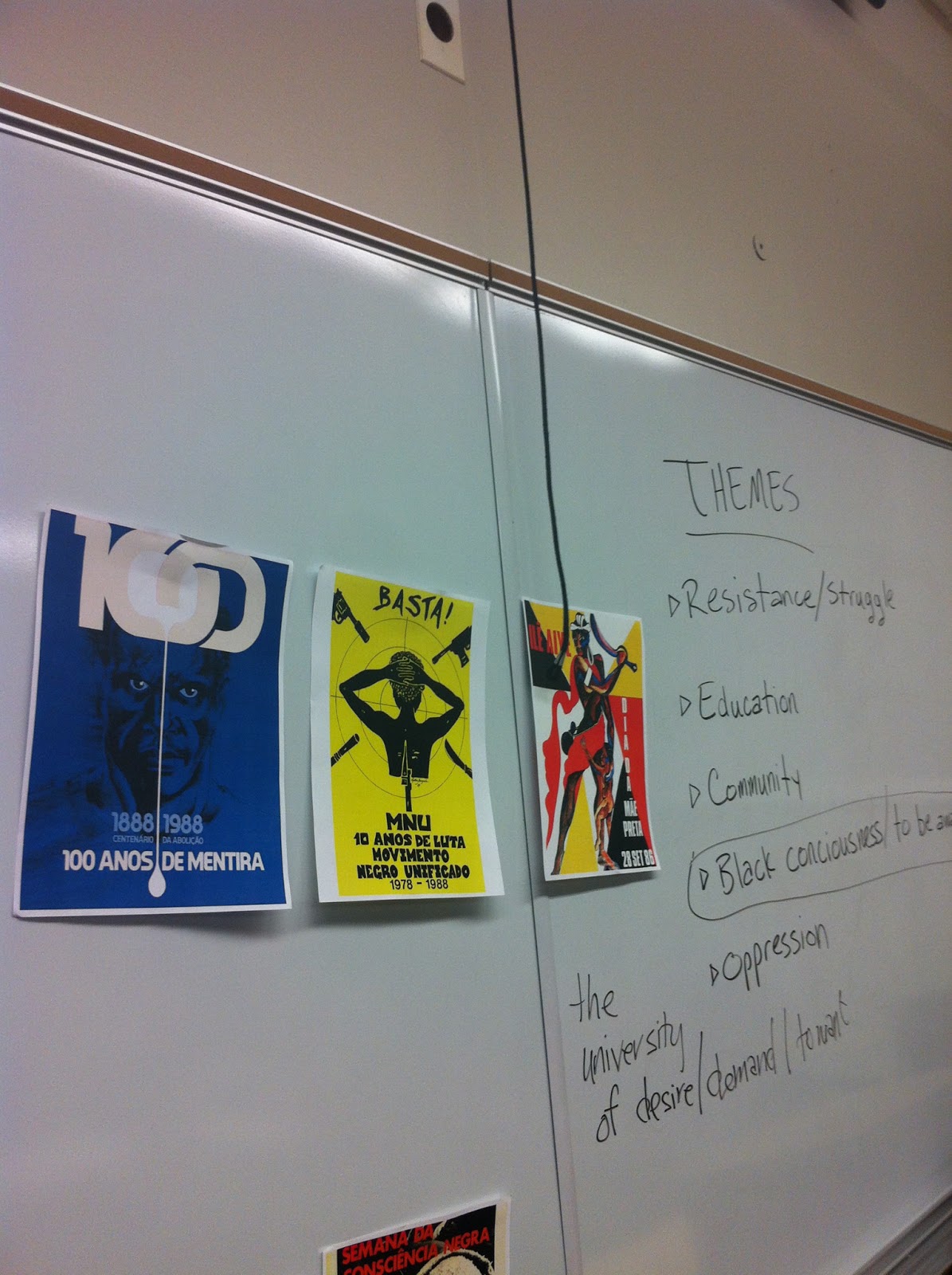
While working on their weekly readings concerning African American life in cities, the students in this course knew they would soon be analyzing posters for an upcoming art exhibition. The posters tell a story about the shared struggles of Afro Brazilians and African Americans. The exhibition along with a Brown Bag discussion and lecture by Brazilian researchers Amilcar Periera will be held at the University of Alabama on April 23. University of Alabama Assistant History Professor Teresa Cribelli is the lead organizer. One of her classes is also analyzing a select group of posters. Together, both classes will produce two separate curatorial statements, reflecting impressions of posters. University of Alabama Assistant Professor of Art History Lucy Curzon has provided insight on getting the students to see how art images can "speak." As the photo here demonstrates, the themes that "spoke" to the students enrolled in "African Americans in the City" this semester are resistance, education, community, black consciousness and oppression. Next week, as they continue working on this project, the class will use Ula Taylor's study on Jamaican-born Amy Jacques Garvey, wife of Pan Africanist Marcus Garvey, and Aline Helg's exploration of Afro-Colombians, to explore how "blackness" has different meanings in and outside the United States. How those different meanings still permit people of African descent to share particular experiences and impressions will drive this lesson.

Tuesday, February 19, 2013

"forms of dislocation"


Yael Sternhell's study of Southern movement during the Civil War.
I get it. I know that you can only take comparisons so far. So, for this week’s in-class written reflection, I had mixed feelings about asking the students to think about Hurricane Katrina and the idea of movement in the years leading to and during the Civil War as described by Yael Sternhell in an academic study, and Dolen Perkins-Valdez in her best-selling novel, Wench. After all, the 2005 hurricane was a natural disaster though one involving human decisions on multiple levels. But human decisions also factor into man-made disasters like wars.  I went ahead with the in-class assignment with the hope of pushing the students' critique of African American life in a particular time and across time. I asked them to juxtapose the Sternhell and Perkins-Valdez readings against an excerpt from the Spike Lee HBO documentary “When the Levees Broke." These three works -  one of them historical fiction, describe, however differently, dislocation and racial conflict. For example, in Wench, the students read about the experiences of four enslaved women, all mistresses to white Southern men. The women traveled unaccompanied by their masters to an Ohio city and learned what it was like to order a meal in a tavern and go shopping to purchase anything they wanted for the first time. In literally moving not just from the South, but from their white masters’ presence, there was a psychological opening in how they perceived their oppression. Still, Lizzie, one of the women, could not bear the idea of escaping to “freedom,” something the others successfully contemplated. Demonstrating how the ability of bondswomen to move was different from bondsmen, she worried about her children who were still in slave territory. She also believed her master truly cared for her. Other tensions stemming from the idea of leaving were presented in the assigned Sternhell chapter. In it, the students read about how the Civil War disrupted the social order in the South, causing many to flee regardless of race or gender. Some rural slaves, suddenly free to move, fled to cities like Richmond. Sternhell pondered how emancipation, or the idea of freedom, could be considered against “other forms of dislocation” and “with other problems of social control in a theatre of war.” I wondered if the racially charged dislocation of many during Katrina, a storm that took place nearly 150 years after the Civil War, and one involving heated exchanges between local and national public leaders as well as blacks and whites alike could be mapped onto Sternhell’s (and Perkins-Valdez') work. I told the students if they were not persuaded that it could, it was totally okay. I was impressed by the range of positions  they took. Roosevelt wrote, “I don’t see [the connection]. Katrina affected only the people in New Orleans; the Civil War [involved people from the entire South].” Shanece saw a connection, writing, the [woman] in Wench was unable to escape because [she] did not know how [she] would survive... This is [sort of] similar to the Hurricane Katrina disaster [in that] lots of citizens [had similar concerns. They] did not have the finances or means of transportation to relocate.” Alexis observed a connection, observing how during the Civil War, Southern whites and blacks migrated toward [military sites] “for protection and safety] though some Katrina victims stayed for “[economic] reasons; [others simply] did not want to abandon their homes.” Taking a similar position, Christin saw a connection between one’s ability to physically move in New Orleans during Katrina and in the South during the Civil War. As she writes,  in both instances “race determined how successful the move could be and if it [was going] to be permanent.” To this point Tiffany, who also saw a connection, wrote, “Your wealth and status determin[ed] your ability to make decisions.”  Lauria also saw a connection between the two events though rightly with caution, writing, “I think it was by coincidence that the areas that were hit the hardest [during Katrina] were areas with a large African American [population].” She noted how some people did not have the means to rebuild their homes and like many living in the bellum and postbellum periods, discovered it was “easier to start new lives elsewhere.” Aaron saw a connection between the two events, observing the ways in which Katrina “completely dismantled the social order of New Orleans” because everyone “shared in the hardship.” But he acknowledged that in both instances, “it was much easier for whites to move.” I challenged the students to remember how they responded to this prompt and earlier in-class writing prompts as we continue learning about how certain bodies become associated with city life after the Civil War.